The idea arrived on your walk. It began at your desk.
The Art of Thought · Graham Wallas, 1926
How Ideas Are Born is a 29-episode audio course on The Art of Thought, the 1926 book in which Graham Wallas, one of the founders of the London School of Economics, named the four stages of a new thought: preparation, incubation, illumination and verification. The complete book is beside it. Wallas shows where effort helps an idea along, and where it only gets in the way.
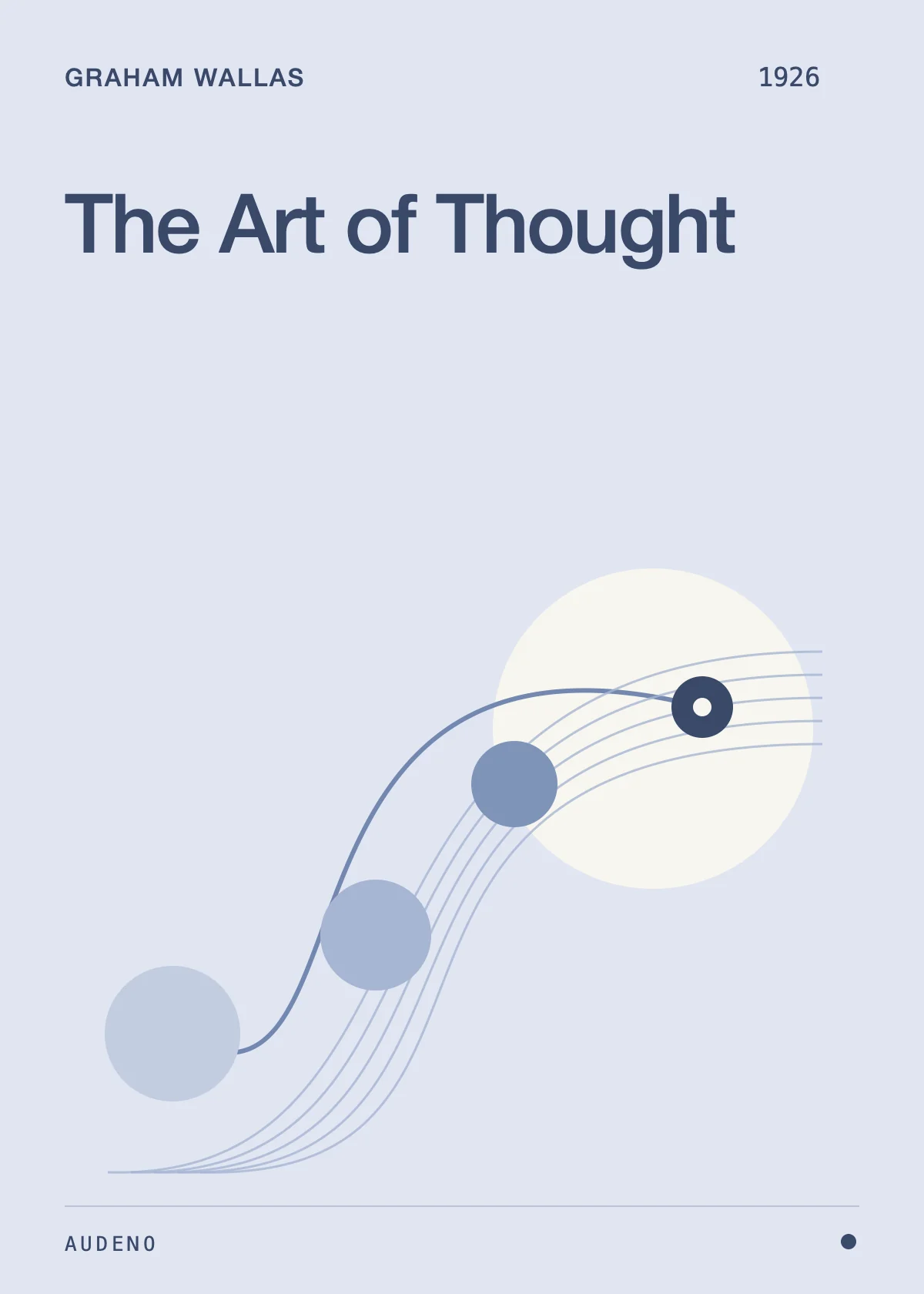
The idea waited for the shower
All afternoon you sat with the client proposal. You reread the brief, opened three old decks, typed a heading and deleted it. Then, in the shower that evening, you saw it: the client never asked for more features, only for fewer steps. The idea took two seconds. It is tempting to decide that the afternoon was wasted and the shower did the work.
Graham Wallas saw both moments as parts of one process, and in 1926 he named its stages. He began with the physicist Hermann von Helmholtz, who told a banquet on his seventieth birthday that his best ideas had never come “when my mind was fatigued, or when I was at my working table,” but came readily “during the slow ascent of wooded hills on a sunny day.” They came, though, only after he had investigated the problem “in all directions.” Wallas called that first stretch Preparation, the time away Incubation and the arrival of the idea Illumination.
He added a fourth stage, Verification, from the mathematician Henri Poincaré, for whom an inspiration offers only “points of departure” for calculations that still have to be made. Wallas knew the pattern from his own life: his newest thoughts tended to arrive with “the first spongeful of water in my bath,” and he never found the courage to shop for a waterproof writing-tablet.

How Ideas Are Born
The first 4 episodes, free.
The introduction and the first lessons of the course, exactly as they sound in the app. No sign-up.
Keep going with The Art of Thought
The complete course has 29 episodes and 153 minutes of audio. One purchase per book, no subscription.
See all 29 episodesThe full course is coming to the App Store with Audeno.
What you will explore
A question the mind can work on
An email asking for “an interesting idea to improve efficiency” gives the mind nothing to hold. Asking colleagues where their time went yesterday gives it plenty. For Wallas, Preparation is real work: gathering knowledge, dividing up the field, adopting a definite “problem attitude.” The first three lessons, free to hear, follow a birthday speech, a vague brief at work and the front door of a small library until each one gives thought somewhere to move.
A pause with something in it
Helmholtz’s walks worked because the problem had already been investigated. Wallas also warned that the most dangerous substitute for real rest during Incubation is “the habit of industrious passive reading,” a habit that now fits in a pocket. The course compares two breaks, one of messages and short videos, one of a walk past an old cinema, and brings in later research: in a review by Ut Na Sio and Thomas Ormerod, the effect of a pause varied with the task and conditions, larger where preparation was longer and smaller where the break was filled with demanding mental work.
The moment before the answer, and the morning after
Wallas gave a name, Intimation, to the moment when you sense an answer coming before you can say what it is. It is fragile: it drifts off like a dream or breaks at the ring of a telephone. Words can scare it away, yet a little girl he quotes, told to be sure of her meaning before she spoke, answered: “How can I know what I think till I see what I say?” After it comes Verification, “with her lame foot and painful step.” The course follows a neighbors’ tool-sharing list that nobody used, one drill at a time, until it becomes an arrangement people feel comfortable with.
The important thing sends no reminder
In the most critical months of the war, the administrator Sir Warren Fisher began each day with his back to the fireplace, not yet looking at the urgent files on his desk, and asked the senior officials before him: “Now, you fellows, what is the most essential thing for us to get done today?” Wallas gathers habits like this one, from Dickens arranging ornaments on his table in a certain order to a friend who started work by copying out yesterday’s last few sentences, and insists that a thinker “must be the master and not the slave of his habits.”
Is this book for you?
- You need a good idea by Friday, and the harder you push, the quieter your mind gets.
- Your best thoughts arrive in the shower or on the stairs, and are gone before you find a pen.
- By evening every message has an answer, and the question that matters is still untouched.
The Art of Your Own Thought
- ↗Free
Before a Thought Has Words
Introduction · 3 min · Meet Wallas and discover where the art of thought belongs in ordinary life.
- 01Free
Why You Cannot Order an Idea to Arrive
Lesson · 6 min · Why an order to invent can leave us stuck, and how we can help thought begin.
- 02Free
A Question You Can Actually Work On
Lesson · 6 min · Turn a vague assignment into a question the mind can work with.
- 03Free
Looking Is Not Yet Seeing
Lesson · 6 min · A library entrance reveals the difference between collecting information and noticing something.
- ❝In the full course
A Thought on a Sunny Hillside
Author’s words · 3 min · Wallas in his own words: Helmholtz, a sunny hillside, and the arrival of a thought.
- 04In the full course
What Happens When You Step Away
Lesson · 6 min · What an interval gives a prepared question, and why the kind of break matters.
- 05In the full course
I Cannot Explain It Yet, but There Is Something
Lesson · 6 min · Attend to the moment when an answer has not arrived, but something is beginning to form.
- 06In the full course
From an Exciting Idea to Something That Works
Lesson · 6 min · A neighborhood tool-sharing idea shows how verification continues the creative work.
- ↺In the full course
The Table with No Room for Dinner
Review · 4 min · One kitchen table brings the four stages together in a familiar story.
- 07In the full course
Why One Thought Stays with You
Lesson · 6 min · How a feeling of significance gives attention direction and keeps a question alive.
- 08In the full course
Words You Can See Through
Lesson · 6 min · A conversation about choosing a film reveals the creative power of understandable language.
- 09In the full course
Finding Your Way Back into Yesterday’s Thought
Lesson · 6 min · Find an entrance into yesterday’s work, and recognize when a familiar route needs to change.
- 10In the full course
The Important Thing Sends No Reminder
Lesson · 6 min · Why an important question disappears among urgent requests, and how it can enter the day.
- 11In the full course
A Note That Comes Alive a Month Later
Lesson · 6 min · A grandmother’s story emerges as separate memories begin speaking to one another.
- ❝In the full course
How Scattered Thoughts Become a Whole
Author’s words · 3 min · A complete passage on records, different working methods, and thoughts becoming a whole.
- 12In the full course
Easy Words, but Is There Anything to Say?
Lesson · 6 min · Fluent writing can grow from living skill or familiar repetition. What makes the difference?
- ↺In the full course
The Story That Asked for Nothing
Review · 4 min · Dmytro’s night-bus story brings attention, habits, notes, and energy into one undertaking.
- 13In the full course
Minds Do Not All Take the Same Route
Lesson · 5 min · A neighborhood celebration shows how principles and practical experience can work together.
- 14In the full course
The Feeling of Certainty and the Thought Itself
Lesson · 6 min · From the excitement of a hunch to understanding what we have actually found.
- 15In the full course
The First Time You Speak for Yourself
Lesson · 7 min · How an observation of your own helps you move beyond repeating someone else’s words.
- ❝In the full course
A Place for a Future Thinker
Author’s words · 3 min · Wallas imagines a school that protects individuality and makes room for a student’s future.
- 16In the full course
A Room Where Thinking Is Possible
Lesson · 6 min · How conversation, surroundings, and organization give a new thought a chance to be heard.
- 17In the full course
Why Your Thought Needs the World
Lesson · 6 min · For Wallas, the art of thought belongs to people, shared life, knowledge, and beauty.
- 18In the full course
An Idea You Can Now Hand to Someone
Lesson · 6 min · Follow Olena’s idea from an unclear assignment to something other people can use.
- ?In the full course
When Ideas Have to Fit into Real Life
Conversation · 6 min · A conversation about short intervals, fatigue, routine work, and ordinary rest.
- ?In the full course
When There Are Too Many Ideas, or None
Conversation · 6 min · What happens when knowledge is scarce, ideas multiply, notes pile up, or a good thought is forgotten?
- ?In the full course
When Your Own Voice Is Still Quiet
Conversation · 6 min · Speak for yourself, share unfinished work, and use feedback while preserving your own voice.
- ?In the full course
When a Thought Needs to Become Finished Work
Conversation · 6 min · Unsuccessful attempts, persistence, completion, and the moment a thought meets other people.
- ✓In the full course
Your Thought Is Still Unfolding
Closing · 3 min · Return to the unfinished thought and the room it leaves for your participation.
In the author’s words
A few lines from the book, kept in context: each one leads to its place in the text.
I find it convenient to use the term “Intimation” for that moment in the Illumination stage when our fringe-consciousness of an association-train is in the state of rising consciousness which indicates that the fully conscious flash of success is coming. A high English civil servant described his experience of Intimation to me by saying that when he is working at a difficult problem, “I often know that the solution is coming, though I don’t know what the solution will be,” and a very able university student gave me a description of the same fact in his case almost in the same words.
Voluntary abstention from conscious thought on any particular problem may, itself, take two forms: the period of abstention may be spent either in conscious mental work on other problems, or in a relaxation from all conscious mental work. The first kind of Incubation economizes time, and is therefore often the better. We can often get more result in the same time by beginning several problems in succession, and voluntarily leaving them unfinished while we turn to others, than by finishing our work on each problem at one sitting. A well-known academic psychologist, for instance, who was also a preacher, told me that he found by experience that his Sunday sermon was much better if he posed the problem on Monday, than if he did so later in the week, although he might give the same number of hours of conscious work to it in each case.
The art of thought, like the art of running, or the actor’s art of significant gesture, is an attempt to improve by conscious effort an already existing form of human behaviour. Men ran for countless generations before they invented or handed down the few expedients which constitute the art of running as taught by professional athletic trainers; they revealed their feelings by gestures long before there were any schools of dramatic art; and they thought for thousands of years before they had a name for thinking. In all these cases, therefore, the rules of art must be based on the most exact knowledge which we can obtain of the behaviour which the art is to modify.
The Art of Thought
The Art of Thought is more than its four stages. Graham Wallas built it, as his preface says, on more than forty years as a teacher and administrator, and on accounts of their own thinking from poets, students and friends in England and America. From the stages he moves on to emotion and language, habit and effort, the ways professions and nations train the mind, and schools that leave room for a pupil’s own thought. At Shrewsbury, where he went to school, a saying of Dr. Kennedy’s was still handed down: “There is a great deal of Horace in this copy of verses, and a great deal of Vergil, but nothing horatian and nothing vergilian.” Wallas hoped his book would help “a few young thinkers in the practice of their art.” Audeno has the complete 1926 text and a full Ukrainian translation made for the app.
12 chapters · about 79,000 words
Contents
- The Art of Thought
- Preface
- Synopsis of Chapters
- Psychology and Thought01
- Consciousness and Will02
- Thought Before Art03
- Stages of Control04
- Thought and Emotion05
- Thought and Habit06
- Effort and Energy07
- Types of Thought08
- Dissociation of Consciousness09
- The Thinker at School10
- Public Education11
- Teaching and Doing12
- Index
Get the full course
How Ideas Are Born: The Art of Thought
Free
- The full text of the book
- Every quote, with its place in the text
- The introduction and the first three lessons
- Texts offline; each lesson stays on your iPhone after its first play
One purchase, $4.99 in the US
- All 29 episodes of the audio course
- Every language the course has, now and later
- Restore on any iPhone with your Apple Account
- No subscription
Coming soon to the App Store in the United States, Canada, New Zealand, the United Kingdom, Ireland and Ukraine. Until then, the free episodes and the full text of this book are here on this site.
Questions
What are the four stages of thought in The Art of Thought?
Wallas draws them from single achievements of thought, traced from beginning to end. Preparation: the problem is investigated “in all directions.” Incubation: you stop thinking about it consciously, by working on something else or by resting. Illumination: the “happy idea” appears, often announced by what Wallas calls Intimation, the sense that a solution is on its way. Verification: the idea is tested and given exact form. In the daily stream of thought, he adds, the four stages “constantly overlap each other,” so the course treats them as a map, not a ritual.
Is The Art of Thought only for artists and scientists?
No. Wallas draws on Helmholtz and Poincaré, but also on a preacher preparing a sermon, a civil servant at a difficult problem, an administrator choosing the day’s priority, and “a business man going through his morning’s letters.” The course stays with ordinary scenes: a birthday speech, a vague brief at work, a neighborhood exhibition, a kitchen table with no room for dinner. You do not have to call yourself creative. It is enough to want a thought of your own, not only a borrowed one.
Does the course draw on modern research?
Briefly, in two lessons, and only where it sheds light on Wallas. Benjamin Baird and colleagues (2012) found that people who spent a break on an undemanding task that let their minds wander improved more on unusual-uses problems they had already seen than some comparison groups. A 2009 review by Ut Na Sio and Thomas Ormerod found that the benefits of incubation varied with the task and the conditions. Marily Oppezzo and Daniel Schwartz (2014) found that walking helped people come up with varied, appropriate ideas, though not every kind of task benefited equally. The course presents these as parallels to Wallas’s account, with their limits, and keeps the focus on his book.
How long is the course, and what is free?
29 episodes, about two and a half hours in English: an introduction, 18 lessons of about six minutes each, three readings of Wallas’s own pages, two recaps, four conversations on the questions that may remain, and a short closing. In Ukrainian the course runs about 2 hours 45 minutes. The complete text in English and Ukrainian, the quotes, the introduction and the first three lessons are free in the Audeno app on iPhone. One purchase, 4.99 USD in the US and adjusted by country, opens the whole audio course in English and Ukrainian, and in any language added later. No subscription, and the course can be downloaded for listening offline.
What does the purchase open?
The complete audio course of this book, all 29 episodes, in every language it has now and every language added later. One purchase at the App Store price, $4.99 in the United States, adjusted by country. No subscription.
Can I listen offline?
Yes. Each lesson downloads the first time you play it and then stays on the iPhone; a course you own can be downloaded whole for listening with no connection. The text and quotes are inside the app.
Also in Audeno

The Art of Thought
How Ideas Are Born is a 29-episode audio course on The Art of Thought, the 1926 book in which Graham Wallas, one of the founders of the London School of Economics, named the four stages of a new thought: preparation, incubation, illumination and verification. The complete book is beside it. Wallas shows where effort helps an idea along, and where it only gets in the way.
Coming soon to the App Store. Until then, the free episodes and the full text of this book are here on this site.